

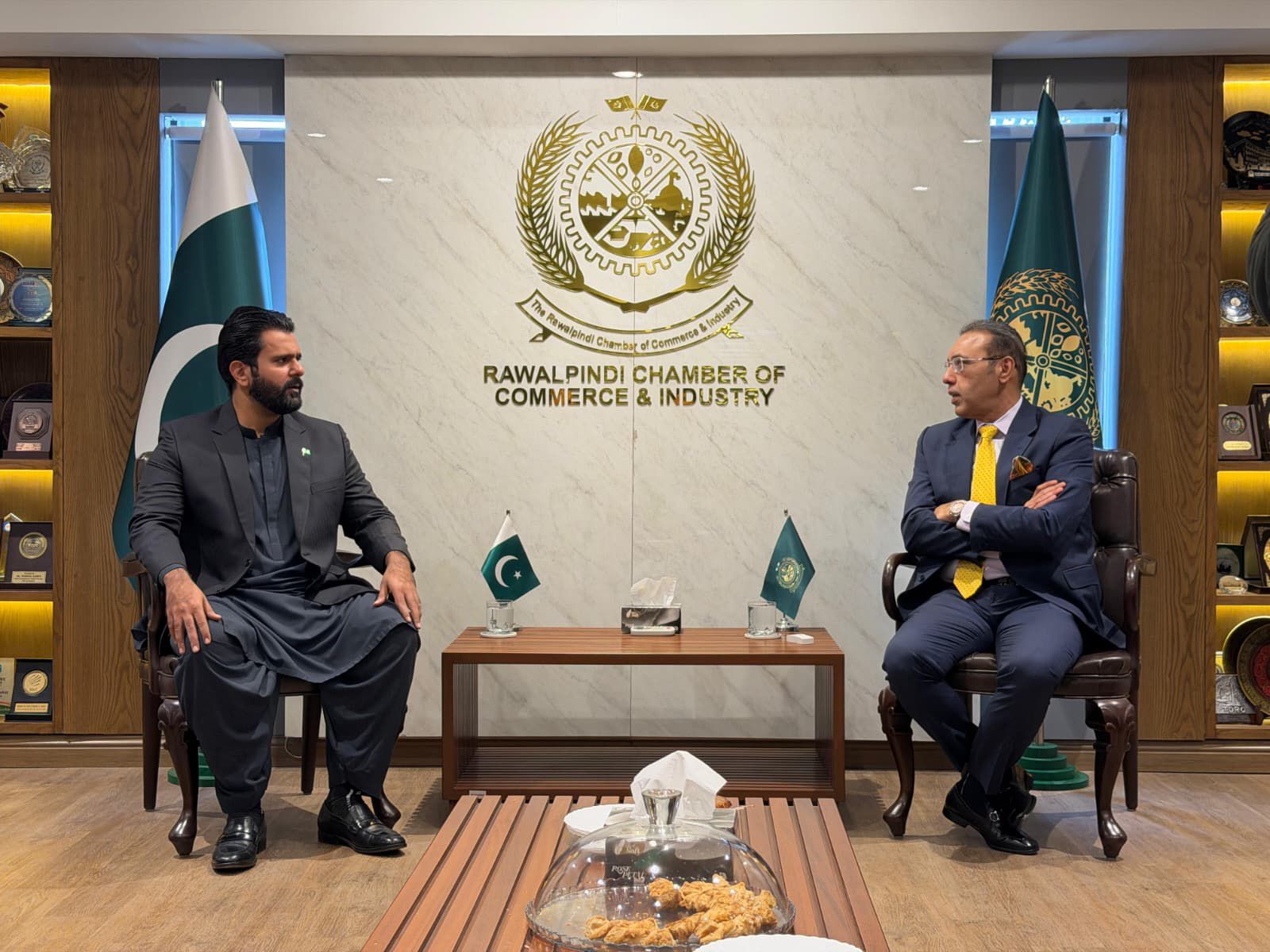
RAWALPINDI: In a landmark visit to the Rawalpindi Chamber of Commerce and Industry (RCCI) today, the Spokesperson for the Government of Sindh termed Sindh the “economic gateway” for the Potohar region, urging the business community to capitalize on the province’s strategic ports, energy surplus, and internationally acclaimed Public-Private Partnership (PPP) opportunities.
During a high-level meeting with RCCI President Usman Shaukat and the executive committee, the Spokesperson emphasized that political boundaries should not impede economic synergy. The visit focused on bridging the “North-South” divide by offering practical logistical solutions to Punjab-based manufacturers.
The “Gateway” to Global Markets
“The distance between Rawalpindi and Karachi may be measured in kilometers, but the distance between our economies must be zero,” the Spokesperson stated. Highlighting the “Gateway Narrative,” the Sindh delegation assured RCCI members that the provincial government is committed to streamlining the movement of goods from Port Qasim and Karachi Port to the up-country, effectively acting as the “lungs” of Pakistan’s trade.
Khairpur SEZ: The Closest Port-Side Facility
A key highlight of the address was the Khairpur Special Economic Zone (KSEZ). Located on the National Highway (N-5) just south of the Punjab-Sindh border, KSEZ was presented as the most logically viable expansion point for Rawalpindi’s industries.
Strategic Advantage: As the first major industrial node entering Sindh, Khairpur offers a “halfway house” for exporters to process goods before they reach the port.
Agro-Industrial Synergy: The Spokesperson proposed a partnership merging Sindh’s raw material surplus—specifically dates and cotton—with Rawalpindi’s advanced packaging and light engineering sectors.
Powering the Grid with Thar Coal & Wind
Addressing energy concerns, the Spokesperson detailed Sindh’s contribution to the national grid through the Thar Coal project and the Gharo-Jhimpir wind corridor.
“The lights powering factories in Punjab are fueled by the resources of Sindh,” the Spokesperson noted, inviting private sector investment into ancillary energy services. “With 175 billion tons of coal reserves and a 43,000 MW potential in wind energy, we are securing Pakistan’s energy future.”
A Model of Trust: The PPP Success
To alleviate investor concerns regarding government stability, the delegation showcased Sindh’s Public-Private Partnership (PPP) model, which has been ranked 6th in Asia by the Economist Intelligence Unit (EIU). The model was pitched as a “de-risked” investment vehicle where the government shares financial stakes, ensuring project longevity and security for investors.
Call to Collaboration
The visit concluded with an invitation for the RCCI leadership to visit the Dhabeji Special Economic Zone, a flagship CPEC project and also the world recognized and award winning Khairpur Special Economic Zone. Nadir Gabol promised full support to the business community.
Infrastructure Revolution:
The Shahrah-e-Bhutto and other dual carriage roads like Karachi -Thatta dual carriage roads facilitate the swift movement of goods from the port to the up-country, the Spokesperson highlighted the newly operational Shahrah-e-Shaheed Zulfikar Ali Bhutto (formerly the Malir Expressway). This 39-kilometer, six-lane access-controlled corridor now serves as a dedicated high-speed artery connecting the Karachi Port Trust (KPT) directly to the M-9 Motorway. By bypassing city traffic, this improved infrastructure drastically reduces turnaround times for logistics companies ferrying raw materials to Punjab, ensuring that the “Gateway to Pakistan” remains open and efficient for Rawalpindi’s exporters.
Ease of Doing Business:
The “One Stop Shop” Addressing concerns about bureaucracy, the delegation introduced the Sindh Business One Stop Shop (SBOSS), a revolutionary digital portal that has streamlined the regulatory landscape. The Spokesperson explained that investors can now access over 130 services from 16 different provincial departments—including registration, licenses, and permits—from a single online dashboard. “You can now register your business in Sindh from your office in Rawalpindi,” the Spokesperson stated, emphasizing that the new blockchain-secured system has eliminated the need for physical visits and enhanced transparency for all investors.
Security & Stability:
The Safe City Project Reassuring investors on the law and order front, the Spokesperson detailed the advancements of the Sindh Safe City Project, which has now expanded its Phase II operations into key industrial and commercial zones. The project employs a network of thousands of AI-enabled surveillance cameras equipped with facial recognition and automated number plate recognition (ANPR) linked to a central command center. This state-of-the-art surveillance grid ensures a secure environment for capital and personnel, reinforcing Karachi’s status as a safe hub for domestic and international business.
During the meeting Nadir Gabol Spokesperson for the Government of Sindh also initiated prayers for the Gul Plaza tragedy victims.