

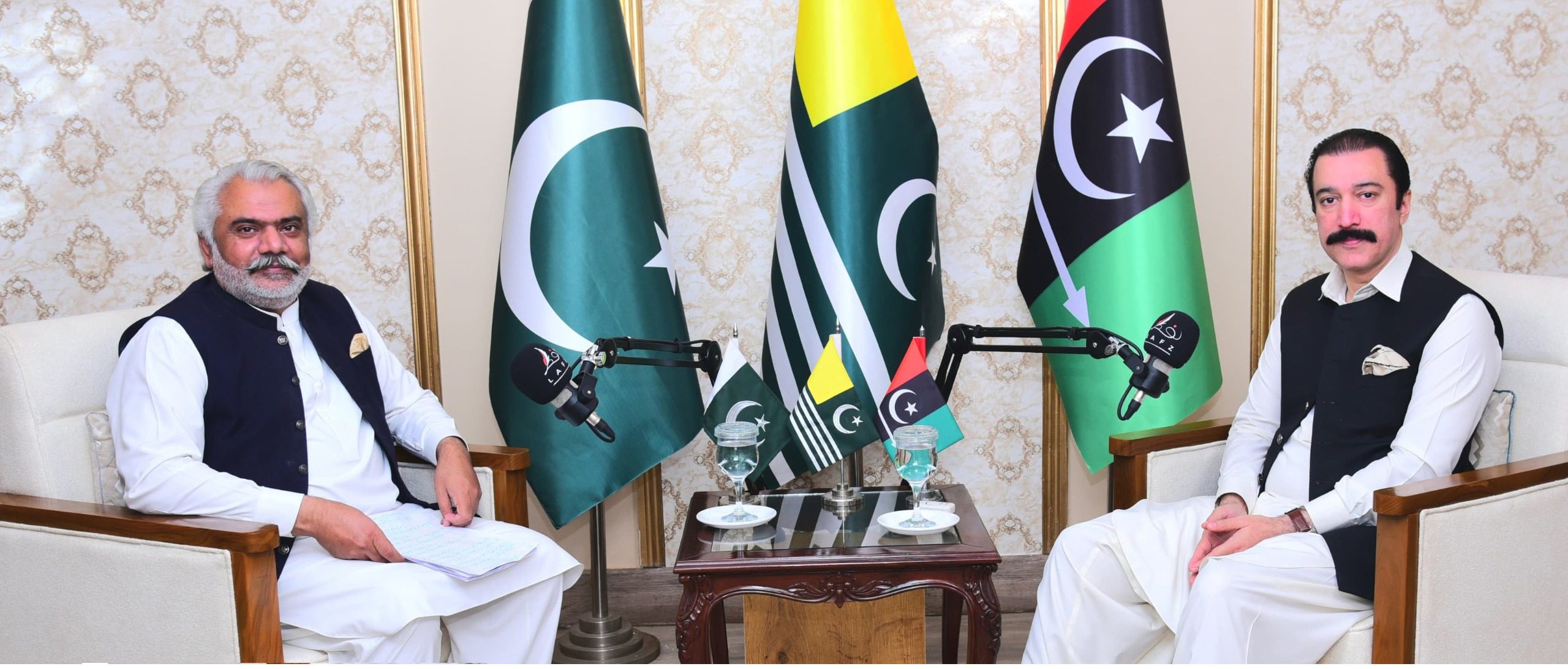
Faisal Mumtaz Rathore stresses dialogue, reforms, and public trust as key to governance in Azad Kashmir
Islamabad: Prime Minister of Azad Jammu and Kashmir Faisal Mumtaz Rathore has said that the decision to form the government was not an easy one for the Pakistan Peoples Party, as the region was facing intense political tensions, uncertainty, and widespread public disappointment at the time.
In a special interview with anchorperson Khawaja A. Mateen, the prime minister said that President Asif Ali Zardari and the party leadership chose to accept responsibility during a critical period, believing that if the PPP did not step forward in such circumstances, no one else would. He emphasized that the party has always believed in resolving issues through dialogue and political engagement.
Rathore stated that immediately after assuming office, the government prioritized public issues and took responsibility for implementing points agreed upon with the action committee. He noted that matters within the jurisdiction of the AJK government were addressed without delay. Through continuous meetings, assembly sessions, and public outreach campaigns, efforts were made to re-establish direct contact with citizens. The doors of the Prime Minister’s House and Secretariat were opened to the public to ensure accessibility and responsiveness.
He said that public trust plays a crucial role in governance. If people believe their elected representatives are listening and committed to resolving their problems, they are willing to tolerate weaknesses. However, once trust is lost, people begin to focus more on shortcomings than achievements.
The prime minister acknowledged that the government inherited a challenging situation but within six to seven months, it worked to establish sustainable pathways that future governments could continue. In this regard, he announced that a major agriculture conference would be held in Azad Kashmir on April 20, aimed at promoting self-reliance and strengthening the local economy.
Rathore cautioned against repeated protest movements, road blockades, and unrest in the state, recalling that similar actions in the past had resulted in the loss of thirteen lives. He stressed that issues should be resolved through negotiations and the political process rather than agitation.
He added that most points of the agreement have been implemented, though progress on the issue of refugee seats is still pending as it involves certain aspects related to the federal government. Other matters, he said, are being addressed gradually.
Responding to a question, the prime minister acknowledged that certain groups had gained public support in the past, partly due to delays in government decisions. However, he expressed concern that these groups now prefer to make decisions on the streets rather than through dialogue. He reiterated that the government seeks to resolve issues through discussion and institutional mechanisms.
Rathore highlighted that significant efforts were made to restore administrative order in the state. He maintained that during his tenure of over four months, he has neither threatened nor spoken negatively about members of the action committee in any media interaction. Instead, he has consistently referred to them as brothers and invited them to work with the government for the betterment of the state.
He underscored that only one system can function in the state, warning that parallel systems would lead to chaos and potential damage. He noted that the social fabric of the region is closely interconnected through tribal, personal, and political ties, and instability could have serious consequences.
The prime minister reiterated that the government remains committed to addressing legitimate public demands and rejected claims that it is working against the people. He said all policies and initiatives are aimed at ensuring stability and public welfare.
He made it clear that while peaceful protest is a democratic right, no one will be allowed to take the law into their own hands or paralyze state institutions under the guise of protest.
Rathore also highlighted that historic decisions have been made in coordination with the federal government on electricity pricing and other key issues, directly benefiting the people of Kashmir. He reaffirmed the government’s commitment to ensuring that the resources of Kashmir primarily benefit its residents and expressed his vision of transforming the region into a peaceful and developed state with the support of its people.