

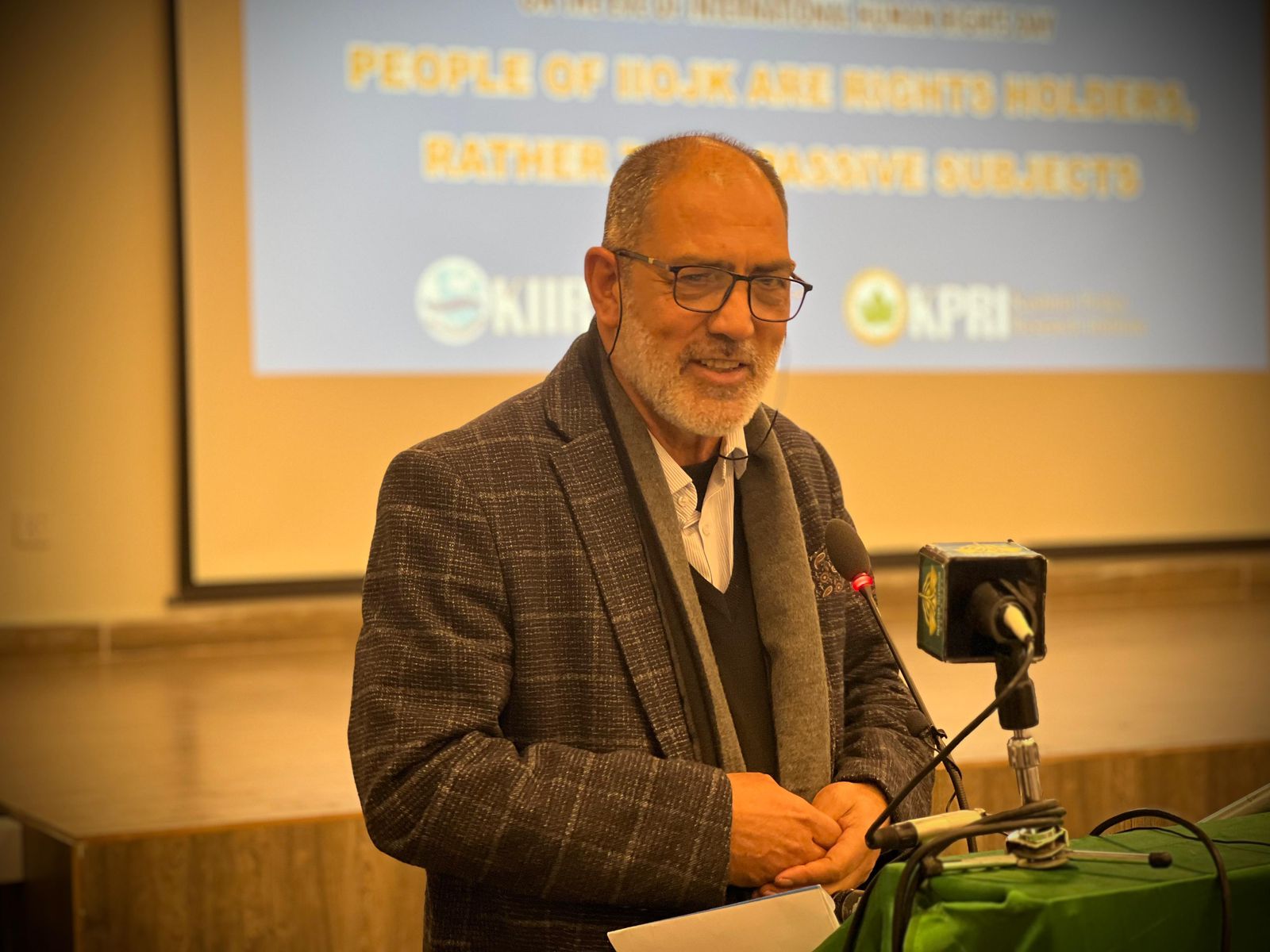
Altaf Hussain Wani
The recent news from Indian-occupied Jammu and Kashmir reveals a chilling pattern: mass arrests under opaque labels, hollow local governance, and espionage allegations trailing Kashmiris beyond their homeland. These are not isolated incidents but deliberate threads in a tapestry of repression, woven by the Indian state to extinguish Kashmiri political will and normalize permanent subjugation. These policies are not security measures; they constitute a systematic campaign to dismantle community, criminalize dissent, and deny a people their fundamental birthright: the right to self-determination enshrined in United Nations Security Council resolutions.
The latest “sweeping crackdown” detaining approximately 200 youth as “Over-Ground Workers” (OGWs) exemplifies collective punishment. This deliberately vague military construct serves as a catch-all pretext to incarcerate ordinary civilians. By severing presumed “support structures” for resistance, the occupation atomizes society, transforming family and community into liabilities. This manufactured “climate of fear” means any young Kashmiri can disappear into detention without transparent legal basis, often under draconian laws like the Armed Forces Special Powers Act (AFSPA), Public Safety Act (PSA), or Unlawful Activities (Prevention) Act (UAPA). These statutes sanction preventive detention for years, overriding fundamental rights. Such operations signal that existence under occupation demands silent compliance.
This collective punishment extends beyond mass detentions. Lieutenant Governor Manoj Sinha’s recent warning threatens severe consequences for any association—“directly or indirectly”—with families of detained leaders, activists, or critics of government policy. This directive institutionalizes guilt by association, imposing social and political isolation on dissenting voices. It punishes entire networks for their beliefs, embodying a strategy designed to fracture societal solidarity. When combined with the OGW arrests, it becomes clear: the state seeks not to target individuals but to terrorize the entire populace into submission.
The poignant admission by Chief Minister Omar Abdullah exposes India’s grotesque facade of “normalcy.” When the region’s elected leader confesses he lacks control over police and intelligence agencies, condemns mass arrests and house demolitions, yet cannot reopen major tourist destinations like Gulmarg because New Delhi holds the keys, he confirms what Kashmiris have always known: democracy’s trappings are hollow. Real authority rests unequivocally with the Lieutenant Governor and his centrally-appointed security apparatus. Abdullah’s candor underscores that the political process within India’s administrative framework is a managed performance, with critical decisions on life, liberty, and economy remaining in occupation hands. How can normalcy exist when the economy is strangled by security closures, local government is puppetry, and credible political leadership languishes in detention under UAPA?
The narrative of suspicion extends beyond Kashmir’s borders. The arrests of Hilal Ahmed and Nazir Ahmad Malik in Arunachal Pradesh—despite valid permits—demonstrate how Kashmiris are framed as spies across India. This vilification of Kashmiri Muslims, whether students, traders, or businessmen, fuels majoritarian suspicion and institutionalizes religious profiling. In this environment, Kashmiri identity itself becomes a potential crime. The pattern of mysterious killings of Kashmiri youth in other Indian states, routinely inadequately investigated, completes this picture of a targeted community living under perpetual threat.
These actions assault the Kashmiri people’s birthright to self-determination, a right recognized by numerous UNSC resolutions. Rooted in international law and historical agreements, this legitimate demand faces India’s response of militarization, legislative strangulation, and propaganda. The reopening of decades-old, often baseless FIRs ensures no one escapes the state’s long memory, perpetuating legal harassment across generations.
This reality has not escaped international scrutiny. United Nations Special Procedures have repeatedly warned India about “the pattern of arbitrary arrests, detention, and torture” in Kashmir. The Concerned Citizens’ Group (CCG) detailed report corroborates these concerns, documenting how anti-terror laws like UAPA criminalize all political dissent, impose severe restrictions on assembly and movement, and maintain a pervasive climate of fear. The CCG confirms that India’s legal and security framework functions not against specific threats but as a blanket instrument of control over Kashmiri society.
The strategy is transparent: through mass detentions, criminalized associations, neutered local politics, and the projection of Kashmiris as perpetual internal enemies, India seeks to crush the foundations of Kashmiri identity and political aspiration. It is a relentless war of attrition against a people’s right to determine their own future, fought in detention cells, courtrooms, and daily life under occupation.
This systematic oppression cannot be sanitized as “internal security” or dismissed as a domestic matter. When a state deploys laws designed for terrorism against an entire population’s political consciousness, it commits a crime against humanity. The international community’s expressions of concern, while welcome, have proven insufficient. What Kashmir requires is not more observations but concrete action: targeted sanctions against officials responsible for systematic rights violations, international investigation into detention practices, and renewed diplomatic pressure to honor UNSC commitments. The silence of powerful nations, prioritizing strategic partnerships over human rights, enables this machinery of repression to operate with impunity.
Yet despite this crushing grip, Kashmiri identity endures. Each arrest, each demolished home, each humiliating checkpoint inadvertently forges stronger bonds of solidarity. The occupation’s fundamental miscalculation lies in believing that fear can permanently substitute for legitimacy. Generations have grown up under this repression, and rather than breaking their spirit, it has crystallized their determination. The young people arbitrarily labeled OGWs represent not a security threat but a political generation refusing to accept erasure.
The question before the world is not whether Kashmiris will continue to resist—history has answered that—but whether the international community will finally match its principles with action. Self-determination is not a gift to be granted when convenient; it is an inalienable right to be restored. Until that restoration, India’s occupation will remain what it has always been: a brutal colonial project destined for the dustbin of history, while the Kashmiri people persist, unbroken, toward their inevitable destiny as masters of their own land and fate.
Writer is chairman of Kashmir Institute of International Relations and can be reached at. chairman@kiir.org.pk or saleeemwani@hotmail.com