

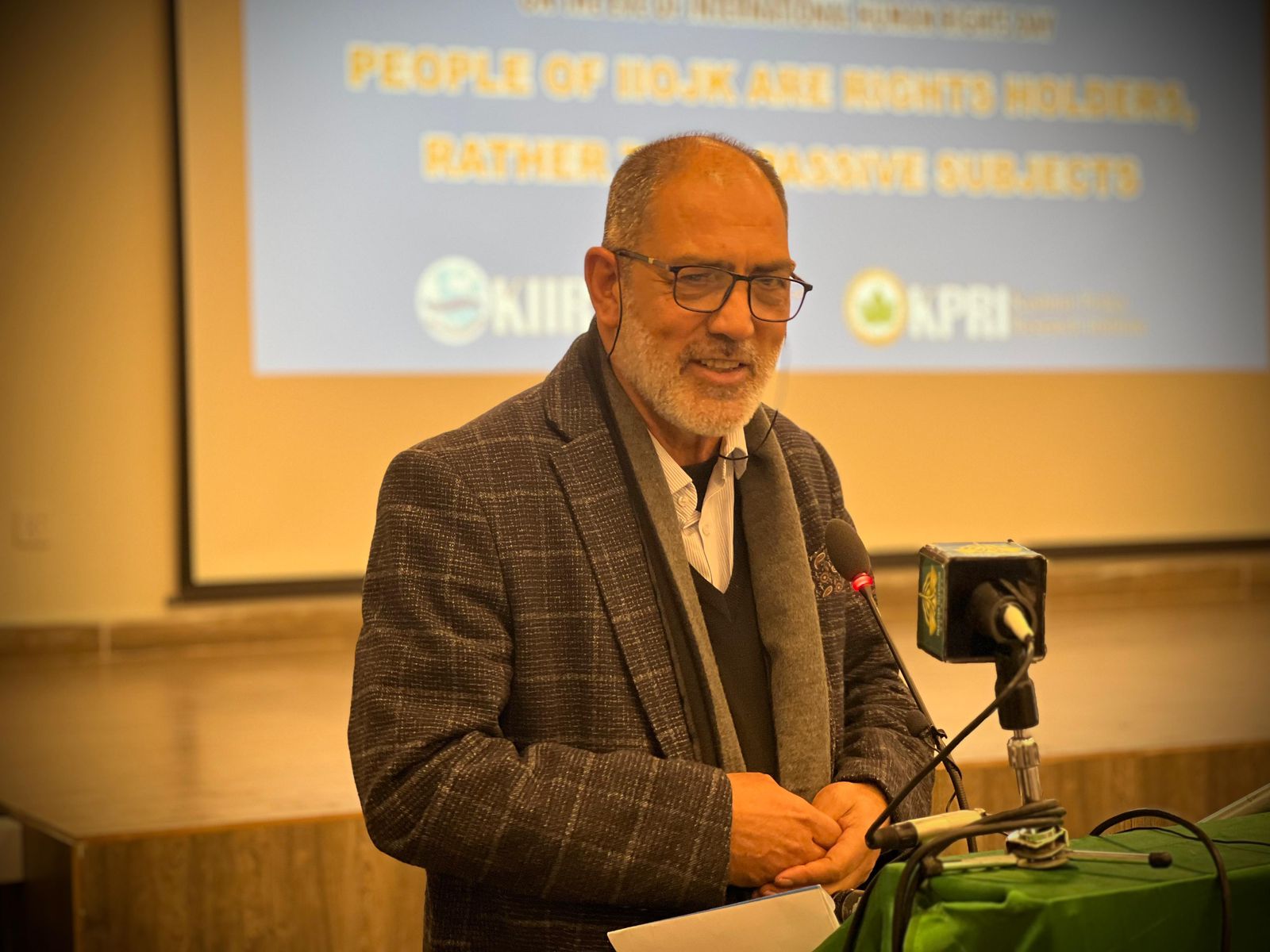
Altaf Hussain Wani
In the carefully curated theatre of “normalcy” that India attempts to stage in occupied Jammu and Kashmir, even the smallest, most symbolic gestures are policed with an intensity that betrays a profound anxiety. The recent episode surrounding Mirwaiz Umar Farooq—pressured, as he states, by occupation authorities to remove the title “APHC Chairman” from his social media profile—is not a minor administrative squabble. It is a stark, revealing moment that lays bare the central contradiction of Indian policy in the region. If the All Parties Hurriyat Conference (APHC) is indeed a defunct entity with no public support, as officials in New Delhi and Srinagar routinely claim, then why does the mere use of its titular prefix inspire such fear and necessitate such coercive control?
The Indian state’s actions over the past several years, particularly since August 2019, have been a comprehensive campaign to erase the APHC from existence. Its senior leaders—Syed Ali Geelani remained under house arrest till his passing , Yasin Malik sentenced to life, and countless others including APHC chairman Masrat Alam Butt, Shabir Ahmed Shah Nayeem Ahmed Khan , Syeda Asyia Andrabi and others have been incarcerated. The conglomerate itself and its constituent groups have been outlawed. Government circulars explicitly forbid media from covering their statements. Properties of sympathizers are attached, and the Lieutenant Governor has publicly declared that relatives of APHC members will be barred from government employment, a policy already implemented with vindictive zeal. The message is unequivocal: every channel of expression, association, and even livelihood must be severed from this organization.
Yet, the frantic insistence that Mirwaiz not identify himself as its chairman screams a different truth. It reveals that for India, the APHC is not just a political rival; it is a symbol. It represents a legacy of unified political resistance to what Kashmiris widely perceive as an occupation. It is the ghost at the feast of India’s integrationist project, a reminder that beneath the surface of enforced silence and the orchestrated rallies of a select few, a foundational political dissent remains unresolved.
The debate over who currently holds the chairmanship within the APHC’s is immaterial, whether it is Masrat Alam in prison, or Mirwaiz leading a faction in the Valley. The occupation authorities’ interference in this internal matter proves that their target is not a specific person, but the title itself. The title “APHC Chairman” carries a weight that transcends the individual. It connects to the memory of the mass mobilizations of the 1990s and 2000s, to the narratives of self-determination, and to the enduring political identity that refuses to legitimize India’s constitutional changes imposed by diktat.
This is the power of the “four digits”—APHC. It is a symbolic vessel for Kashmiri aspiration. By trying to ban even its nominal use, India acknowledges that its material power—armies, laws, prisons—has not succeeded in conquering the political imagination of the people. The failure is evident. If New Delhi’s policies of development, “Naya Kashmir,” and the abrogation of Article 370 were genuinely and overwhelmingly popular, the specter of a banned, silenced, and leaderless conference would hold no power. It would be a historical footnote, not a threat requiring daily negation.
The irony is palpable. A state with one of the world’s largest security deployments in the region, having dismantled the region’s autonomy and political status, finds itself unnerved by four letters on a social media bio. This is not the behavior of a confident state that has won the hearts and minds of a population. It is the behavior of an occupying power deeply insecure about the legitimacy of its control, aware that its project rests not on consent but on coercion. The violence of the repression is directly proportional to the potency of the symbol it seeks to destroy.
The people of Jammu and Kashmir, navigating an unprecedented landscape of demographic and political re-engineering, read these actions clearly. Their continued faith, as noted, lies with the leadership that is behind bars, not with those anointed by New Delhi to fill the vacuum. The authorities can imprison the person, but by trying to erase the title, they admit they cannot imprison the idea it represents. Every FIR filed against someone for mentioning the APHC, every property attached, every media gag order, and now, every pressure applied to change a social media handle, is a testament to the unresolved Kashmir dispute. It is an admission that the “four digits” symbolize a resistance that outlives bullets, laws, and internet shutdowns—a resistance of memory and political will that continues to cast an unyielding shadow over the machinations of power. Until that core political question is addressed justly, no amount of erasure can bring the peace India claims to seek. The very fear of the title proves its enduring resonance.
The writer is Chairman KIIR and can be reached at: chairman@kiir.org.pk