

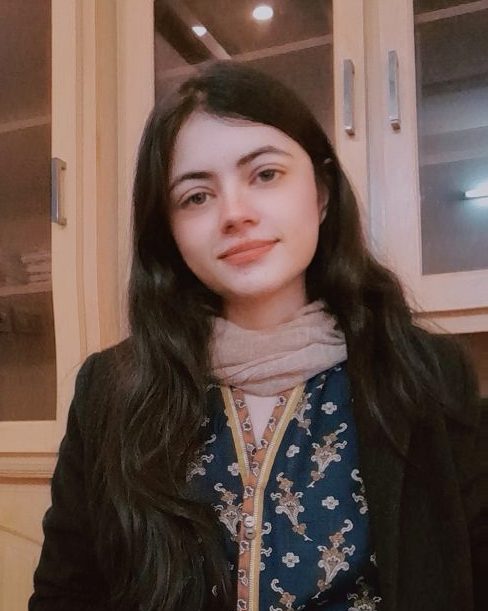
Aleena Zafar
Danish Rajab lost his sight at the age of 24. It was July 17, 2016, in Srinagar. He was not holding a weapon. He was standing by a vendor, like many young men do on a normal summer night, when Indian occupational forces opened fired with pellet shotguns. Hundreds of small metal balls shot out of a shotgun. One tore his left eye apart. Others embedded in his face. Now, Danish can only perceive shadows from his right eye. An X-ray still reveals the pieces of metal lodged in his body, a reminder of that day so long ago. His is not a unique tale in Kashmir. That is what makes it unbearable.
Indian occupational forces have long relied on firing shotguns as a crowd control measure in IIOJK. They are often described as “non-lethal” weapons, a term that sounds clinical, even harmless. Yet, in Kashmir, this is a bitter irony. Human rights groups and medical researchers tell a different story.
Within eight months of July 2016 to February 2017, official statistics showed 6,221 people were damaged by pellet guns and 782 people became blind. Even the Indian government admitted at least 17 people had been killed by pellet guns between 2015 and 2017. Journals of investigation revealed that by 2019 at least 139 people were permanently blinded. At one time during a protest, according to Reuters, pellet guns killed 102, blinded hundreds and wounded thousands.
These are not just statistics. They are stolen futures. A young girl who can’t go back to school because she can’t see to read. A father who cannot work because he cannot see. A mother who borrows money for operations that fail to bring vision back to her son. A young man who once dreamed of becoming an engineer now learning how to walk through familiar streets by memory alone.
Firdous Ahmad Dar lost both his eyes to pellets while protesting at the age of 25. When asked what he misses most he replied, “What I miss most is reading the holy Quran.” Blindness is a cruel thing. It doesn’t just end in the shooting. It comes home. It sits at the dinner table. It makes its way into schools, offices, marriages, prayers. It makes crossing the street, seeing a family member’s face, reading a note, all almost impossible.
And still, the weapons remain. Government authorities justify using pellet shotguns to disperse protesters. They say the police are told not to shoot higher than the waist. But doctors and the wounded have a different view. Pellet cartridges contain hundreds of metal balls. They scatter in any direction. On busy streets, they can wipe out lives. A single shot can blind.
According to Human Rights Watch, they cause “shocking, grievous injuries”. Pellet guns are, according to the United Nations, one of the most dangerous weapons in Kashmir. Amnesty International has reported cases of victims losing their sight and being traumatized. But there’s little accountability. No clear investigations for most victims. No meaningful justice. No guarantees that it won’t happen again. Instead, there is silence. And silence becomes violence.
The families in IIOJK live with the trauma long after the media moves on. Medical debt piles up. Students drop out. Depression deepens. Communities traumatized by the conflict are subjected to an additional burden. Each damaged eye becomes a new scar. Some young people speak of rage, not recovery. Moreover, in 2018, 20-month-old Hiba became the youngest recorded victim when a pellet hit her right eye while she was in her mother’s arms. No forces should allow a weapon that disorients children in the name of crowd control.
The victims deserve better than sympathy. They deserve compensation, medical care, rehabilitation and justice. An independent inquiry must be launched into each incident. The forces who commit human rights abuses deserve accountability as no one has the right to play with people’s future. And finally, Kashmir’s young people deserve more than to survive: they need dignity, hope and empowerment. Because it is not just about pellet guns. It is about what happens when a generation feels their lives don’t matter.
Calling it “non-lethal” is inaccurate. It hides the missing eyeballs. It hides the interrupted education. It hides the mothers waiting outside operating rooms. It hides the X-rays filled with metal dots where a human face used to be. It hides Danish Rajab. But he continues to live in the darkness. Kashmir does not need more weapons marketed with softer language. It needs accountability. It needs healing. It needs their right to self-determination. It needs courage from the powerful to opt for peace over atrocity. Because peace cannot be built through blindness.